

Rhythm of Colours
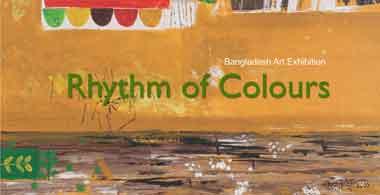
Mijarul Quayes Introduces The Guwahati Exposition Of Contemporary Art From Bangladesh
The land that is today Bangladesh has a history going back millennia and a culture that has roots in pre-history. Successive political changes have influenced the life and life-style of communities here that, in turn, is reflected in the creative genius of contemporary times. There is an organic time-line in the evolution of Bangladesh art all the way through into the modern mainstream. Contemporary art in Bangladesh, therefore, draws as much from heritage as from global trends.
Archaeological relics indicate a rich tradition in terracotta. Indeed, many would consider terracotta embellishments as a distinctive trait of architecture of this land – be it the portrayal of everyday contemporary experience or mythological icons and deities in temples and monasteries, or floral arabesques in mosques. Another major trait dates back to the Pala era (8th-12th Century AD) illustrations on clothing, palm leaves and hand-made papers. These were characterized by an essential harmony and delicate decorative lines that are today considered among the signature characters of Bangladesh art. Alpanas (stylised geometric and floral designs or folk motifs) for festive occasions and pato-chitra (depicting lores and legends on folded screens) are notable elements of Bengali folk art that have become internalized even into the mainstream urban tradition of today.
The roots of modern art in Bangladesh are traced, as indeed, also the beginnings of modern Indian art, to the Calcutta Government School of Art, established by the British Raj in 1864. The Bengal School, spearhead by Abanindranath Tagore (1871-1951), was instrumental in re-introducing the ancient and medieval Indian styles in art. Outside the Bengal School, Jamini Roy’s (1887-1972) works have defined some of the permanent elements of art trends in Bangladesh.
Formalistically speaking, the modern art movement in Bangladesh was pioneered by Shilpacharya Zainul Abedin (1914-1976), Anwarul Huq (1918-1980), Qamrul Hassan (1921-1988), Safiuddin Ahmed (b.1922), Khwaja Shafiq Ahmed (1925-1972), and a few others who had all studied and trained at the Calcutta Art School. They moved to Dhaka after the Partition of India in 1947; and the following year, established what is popularly known as the Dhaka Art College (presently Faculty of Fine Arts, University of Dhaka).
The influence of the Bengal Renaissance notwithstanding, these masters brought a distinctive accent in the art of Bangladesh. From the very beginning, their works were shorn of mythological themes, and although they retained a fascination for folk art forms and motifs, it was more a celebration of the rural rather than nostalgia for some by-gone folk. Modern art in Bangladesh was also very secular for two reasons. One, the reinvention of the ancient and the mythological in the context of Indian nationalism was quite pertinent in British India, but had little relevance in post-Partition eastern Bengal. On the other hand, the appeal of folk art forms and indigenous traditions worked as a brilliant tool against religious inhibition about art in general that was surfacing in post-Partition Pakistan. Works by this first generation of artists, therefore, celebrated rural subjects and themes for their worth – passionately, with bold stokes and bright colours.
Shilpacharya Zainul Abedin, the doyen of the movement is best known for his famous Bengal Famine sketches as also his masterful scrolls that are vibrant for their epic character. In his later days, Zainul took to figurative abstractions accentuated again by the power and value of design in his compositions. Qamrul Hassan found his pulse in the native style and the powerful expression of the patuas. Sensuality of the female figure has featured in many of his major works. He has also done landscapes that bring to life this monsoon-drenched Bangladesh. Safiuddin Ahmed initially worked in woodcut and etchings. After his sojourn in the UK, he concentrated on pure geometric abstractions. One other major artist of the 1940s was S.M. Sultan, whose early works are not readily available. However, after a long reclusive spell, he reappeared in the 1980s, working with natural dyes and colours. He celebrated the peasantry and depicted them on his canvas as powerful protagonists of human civilization.
The first batch of the Dhaka Art College formed the next crop of artists. This generation was predictably varied and diverse – in the choice of figurative expression, the breadth of imagination and the potential of plastic value that they packed into their works. Muhammad Kibria had a natural inclination for semi abstract composition, which was transformed after his Japan phase into the wholly abstract. In Hamidur Rahman, we find the add-on of extraneous elements for effect. Aminul Islam studied mosaics and murals and worked principally in the semi-abstract expressionistic mode. Murtaja Baseer has moved from paintings to murals and stained glass and again back to painting. Rashid Chowdhury’s paintings had surrealistic overtones, but his training in tapestry in France shifted his focus to simple decorative designs. Others of the same generation, working predominantly with abstract and semi-abstract forms, include Qayyum Chowdhury, Abdur Razzaque, Syed Jahangir, Debdas Chakraborty, Kazi Abdul Baset, Samarjit Roy Choudhury and Abu Taher.
Coming after them, but predating the War of Liberation, we have a good number of prolific artists who have created their own individual style and vocabulary. This group includes Hashem Khan, Rafiqun Nabi, Monirul Islam, Mahmudul Huq, Anwar Jahan, Abul Barq Alvi and Hamiduzzaman Khan.
After the independence of Bangladesh, there was a new surge of creativity. There was a natural rediscovery of tradition and the indigenous. A new generation of artists emerged – they adopted a more figurative vocabulary and tried enthusiastically to create an interface between the traditional and the contemporary. As artists of a newly independent country, they also had a new kind of exposure that facilitated their creative pursuit. This group of the 1970s included a good number of sculptors and print makers. Kalidas Karmakar, Shahid Kabir, Abdus Shakoor, Kazi Ghiyas, Monsur-Ul Karim, Chandra Shekhar Dey, Alakesh Ghosh, Shahabuddin, Nazlee Laila Mansur, Alak Roy. K.M.A. Qayyum, Farida Zaman, Ranjit Das and Mohammad Eunus are among the notables.
Artists of the 1980s tried to use tradition and heritage in a more subtle way. There was greater contact with global trends. They have tended towards non-figurative, semi abstract modes of expression. Some have even acquired a post-modern vocabulary- there is infusion of fantasy, humour and the absurd. The 1990s have been hectic. Possibilities became endless as synergies were established between technology and art. Painting and sculpture and even the performing arts, appeared to lose their distinctiveness and became complementary. The same trend continued into the opening years of the new century. If break-up of form described the 1980s and the early 1990s, for the latter 1990s and the beginning of the new century, the mantra is reconstruction.
Today, Bangladesh art is characterized by tremendous creative surge, diversity and vitality. Artists have rediscovered themselves and invented newer individual forte. There is a discernibly increased activity in sculpture and murals. Sculptors have also begun to move on in the choice of material and in the execution of their work. Printmaking continues to draw prolific artists. Installations and digital art, not to speak of multimedia, have offered artists newer directions for fuller expression of their creative genius. There is constant infusion of interesting and refreshing works that testifies to the ease and facility of our new artists as much as the capacity of others to constantly evolve. Opening of private galleries and the numerous exhibitions that are on at any point in time have seen an enhanced interest in the arts and a general increase in both corporate and individual patronage. Institutional contacts between artists at home and abroad and participation in exhibitions, workshops and residencies constantly impact contemporary trends and define directions for tomorrow.
The Guwahati Exposition of Contemporary Art from Bangladesh is curated by the Bengal Gallery of Fine Arts of Dhaka and presents a collection of works by eleven contemporary Bangladesh artists. There are senior artists from the 1960s and later, who are distinguished for their capacity to reinvent their own forte’ and retain an extended sense of the contemporary and a rootedness in the here and the now. And there are the later days’ more recent artists who continue to create newer trends in the creative repertoire of today. It is for me a matter of personal pleasure to be able to introduce their works to the art lovers of Assam.
Qayyum Chowdhury captures the Bangladesh landscape in an inimitable blend of the intense and the sublime. The War of Liberation comes alive in his works, and he can be credited for creating the signature image of the freedom fighter of our War of Liberation. His canvas constantly celebrates the emotive green and the bold red and gold of our patriotic passion.
Tahera Khanam was one of the first four female students to get admitted into the Dhaka Art College in 1954. Although physically a rather diminutive woman, she paints with enormous force and passion. One would be struck by how her canvas comes alive with expressive colours.
Samarjit Roy Choudhury delves in the abstract, shepherding our visual sensibility towards subtleties. His appeal is more to the senses than the merely visual.
Rafiqun Nabi is best known as the creator of Tokai, a popular cartoon character that has for the last four decades provided a perceptive commentary on society. As an artist, his credentials, however, are much more exhaustive recognized for his flawless competence in most media and a capacity for the sublime.
Mahmudul Haque draws extensively from personal insight. Like other painters of the 1960s, he has engaged in discovering the potentials of the abstract, employing different methods and techniques. Despite that his works still exude the fragrance of the monsoon so characteristic of this deltaic land.
Kalidas Karmakar is profusely creative, with an easy facility in multiple media and a distinctive signature to his works. He is contemporary and global in the appeal he invests in the powerful images that he invariably draws from Indic symbolism. His linear images are intense and complex, his prints varied in their technique and multimedia works powerful.
Farida Zaman responds intensely to social realities. Cats, fish, birds, fishing nets and dusky women are recurring subjects in her paintings. She employs a generous play of colours as well as bold forms, but stops short of realistic work. Her abstract themes, like many of her contemporaries, reflect a plebeian social consciousness as opposed to the intellectual.
Nasim Ahmed Nadvi is introspective, intense, but not loud. He has a natural passion for depicting nature in full exuberance. He also has done very expressive works in specially done black and white figures emerging in suggestive light sketched in white emerging from a canvas rendered dark.
Ahmed Shamsuddoha is one of the reputed portrait painters of the country. However, whereas his portraits are realistic and accentuated, we find a propensity to delve in the impressionistic in the superb perspectives that he offers of the rural landscape.
Shishir Bhattacharjee is one of the most influential artists of his generation. His paintings are critical of the political establishment in a satirical fashion. Shishir is best known to a mass audience as a political cartoonist for the largest circulation newspaper of Bangladesh. His style as a political caricaturist has now given birth to a new generation of illustrators who follow his style.
Maksuda Iqbal Nipa enjoys experimenting with colours, particularly yellow, azure, crimson and touches of black. For tools, she uses brush, spatula and knife. Her works are heavily textured and engrossed with varied minuscule forms. She retains this fascination for texture even in her newfound skill in gilding.
This then, is your invitation to the Guwahati Exposition of Contemporary Art from Bangladesh. – your invitation to an exhibition and more – a visual experience that you will indeed celebrate.
Date: 30.10.2011 – 04.11.2011
Venue: Srimanta Sankaradeva Kalakshetra Society Gallery
Organiser: Bengal Foundation