

Sultan Conservation Project
The artist S. M. Sultan’s (1924-1994) works are foundational in the history of modern painting in Bangladesh. What sets Sultan apart is his preference for local knowledge and resources, and rejection of conventional approach. The artist crafted his own canvas using natural jute and hessian and often created pigments by crushing vegetables and roots. Preserving and understanding Sultan’s techniques is crucial for regional specialization and understanding alternative art practices. The Bengal Foundation has one of the largest collections of S M Sultan’s works in its care. Unfortunately, due to the lack of rational technical analysis and informed conservation efforts, many of his paintings have suffered severe colour deterioration and material degradation over the years.
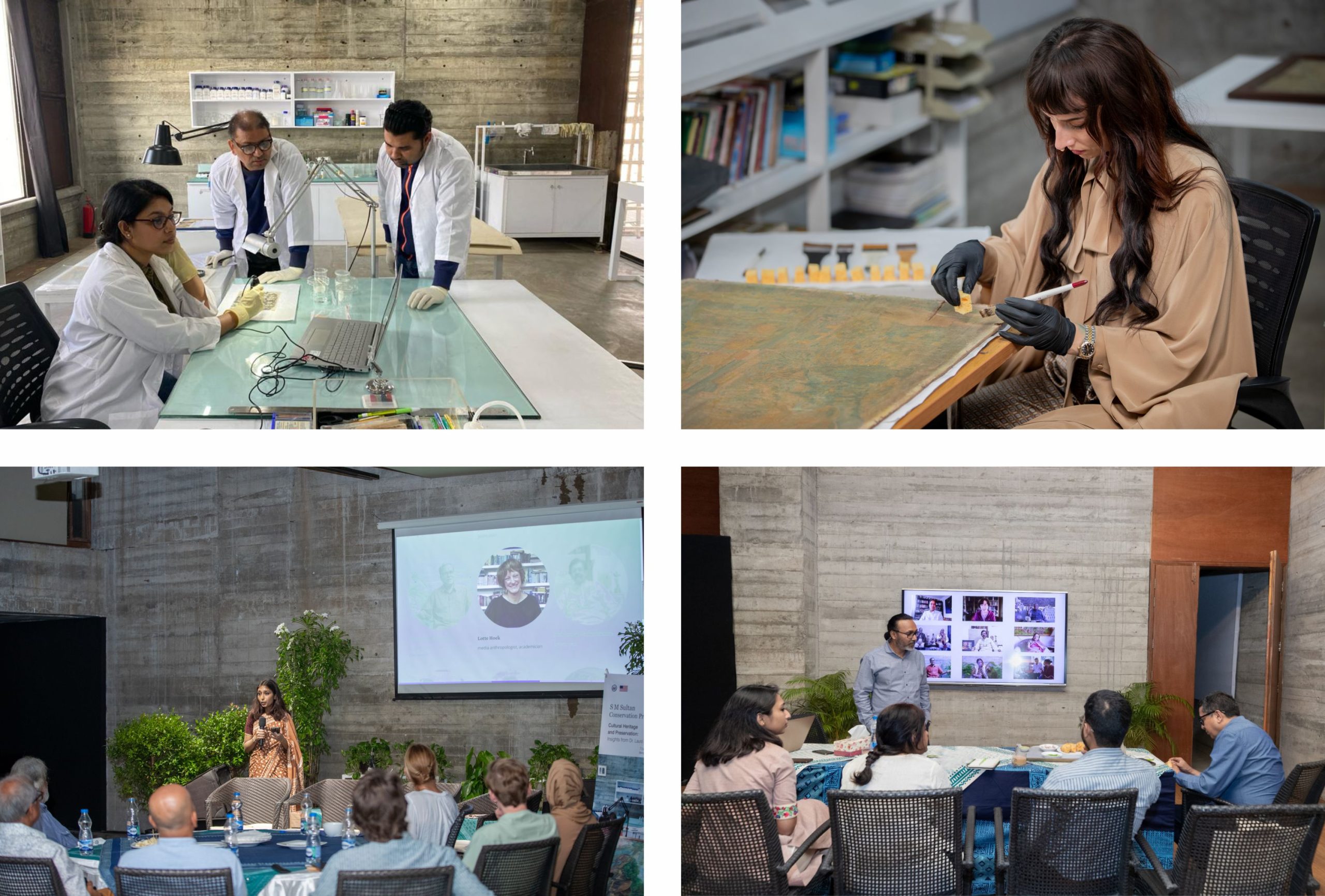
To address the issue, Bengal Foundation undertook the ‘Sultan Conservation Project’ (SCP) in 2021—an initiative dedicated to the conservation of S. M. Sultan’s artworks. Funded by the US Ambassador’s Fund for Cultural Preservation, the project included an extensive study and technical analysis of Sultan’s works, albeit the first such study of its kind. The objectives were to conduct exhaustive art historical research; complete technical assessment of the works; establish a conservation methodology; and finally conserve and restore Sultan’s artworks. The bulk of the conservation work was completed in 2025 with the help of a local team of conservators, under the guidance of a US Conservator. The art historical research is also complete.
Evidence suggests that Sultan himself repaired his paintings, reinforced them with hardboard, and made touch-ups, indicating a level of care and attachment to his art. However, numerous accounts of his life portray Sultan as a wanderer, unsettled and frequently changing locations, often disappearing for extended periods. Sultan was deeply attached to the fishermen and agricultural peasants of his native village in Narail, in south-west Bangladesh. He was politically conscious, and the tumultuous changes of the 40s and 50s in the Indian sub-continent left a strong imprint in his work and influenced his beliefs.
The findings of the art historical research allude to new insights into the artist’s life, his artistic leanings, as well as social and political stance. That led to deliberations on a suitable conservation methodology that leans more towards culturally-sensitive, minimal, non-invasive preservation. Based on the research findings, the effort has been to revive traditional restoration techniques, recreate lost materials, and promote the use of natural materials and dyes.
The SCP has the broader goal of creating an outline for a national policy on the conservation of artworks and the introduction of conservation education.