

Mahmudul Haque 2003
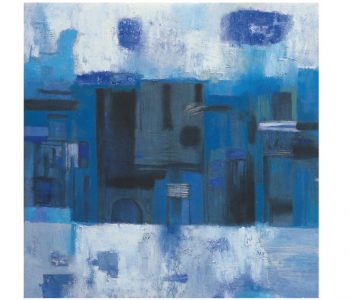
Mahmud’s Abstraction: The Eastern Confluence
In the late 1950’s paintings in Bangladesh underwent a seachange from experiments with basic elements of depiction like line and colour. Breaking away from the norm of representational realistic art, the artists fell in love with stylization of known objects. Their quest for crystallization of objects inspired them to embrace symbolism. But mere delineation of pure forms and their different eye-catching combinations could not charm the artists for long. Through a process of investing new language, experimental art of the country embraced a geometricization that could that could be called pseudo-cubism. Apart from geometric formalism, the art language introduced by artists, determines impressionism enriched with local colors. Mahmudul Haque, a powerful artist of the 1960’s generation has been trying to find a point of reconciliation with geometric formalism where there remains experience of the western academics, folkloric tradition and impressionistic colouring with traces of indigenous art.
Mahmudul Haque has investigated long in botanical motifs which can be made to represent patterns, after being positioned on a two-dimensional surface. From an early stage he was engaged in finding out how figurative motifs matched those of geometry. Mahmud however prefers to replace organic motifs with geometric body through segmentation of chromatic space. But rigid geometry has little appeal to him. He revels in bright colours. Within this geometric form one can detect vaguely, the landscape of the country. Mahmudul Hoque has nurtured the belief since the 1990’s that line, colour and texture in their omnipresent state create abstract feeling. No individual human psyche can work against his time and space. Therefore, his works cannot be homogeneous.
The works displayed in this exhibition are colourful and in terms of composition denote the complexity of emotive mind. On one hand he opts for various textures and patterns, on the other, he uses flat primary colours. This treatment provides us an opportunity to read intricate human psyche by shifting our vision from coloured zones to texture-burdened areas. Mahmud expresses himself basically through various themes of blue and green. His fascination for blue suggests a depth on the flat surface. His romantic imagination also has a stake in his predilection for blue. Given all that, the reason as to why he cannot evade the influence of texture demands some thought. His love for inscribing lines has its root in his skill in printmaking. He pursued higher education in printmaking in North America and Japan. However finally his perception became aligned with the thought process of the orient, a process which is sublimely manifest in the precision of Japanese. Mahmud’s paintings attempt to bridge the link between the moods of Japanese and Bangladeshi art. A blending of the aesthetics of two Asian countries is therefore presented in a refreshing perspective.
The most dominant feature in Mahmud’s work, finally, is the skilful admixture of different media. A minute observation of his recent works would hint at a meditative mind engaged in printmaking, proving his craftsmanship in paintings. In his present works, the physical quality of colours has gone through extensive experimentation. In the end his romantic mind ventures to explore and visualizes through repetitive shifts of colour values. Even a dialect created by the interplay of light and shadow does not deter us from understanding his individual frame of mind, so strong is this feature in his art.
Moinuddin Khaled
March 2003
18/03/2003 – 07/04/2003
Venue: Bengal Gallery of Fine Arts
Entry condition: open to all