

Distant Skies
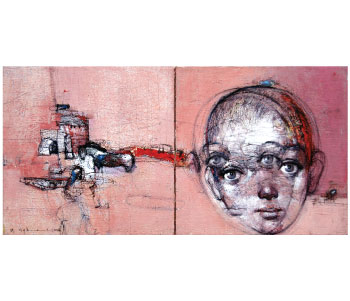
IQBAL’s Unique Artistry
Syed Azizul Huq
Even before Mohammad Iqbal had gone to Japan in 1999 on a Monobusho Scholarship awarded by the government of that country, this gifted graduate of the Institute of Fine Arts of the University of Dhaka had been awarded the best young artist award on two occasions (1994 and 1998) and had attracted the attention of people interested in the Arts by being honoured with a prize in the National Art Exhibition. In Japan he pursued single-mindedly the goal of making himself fit to perform at an even higher level. As a consequence, he was able to win less than five prizes for his artwork exhibited at exhibits at Kurami City and Bridgestone Art Museums.
This exhibition organised by Bengal Gallery of Fine Arts displays the evolution of Iqbal’s art in the eight years that he just spent in Japan. Art lovers of Bangladesh will now come to meet a different Iqbal. Through extensive work with the form and content of art he has acquired a maturity that is remarkable.. At the same time his artistic sensibility has become even more refined. Where civilisation has advanced on the one hand and only to reveal cracks in it on the other, the artistic mind has been disturbed profoundly and has been stirred into a tragic a worldview. In the work he has done since 2003 we find in the circular marks he has arranged carefully on his canvas, emblems of the havoc wrought on our environment by pollution. Through his art he articulated his desire for a solution to this state of things. He yearns fo rpeace instead of the envy, barbarism and sins of war that he sees everywhere. The varied image sof shildren that he has used as a motif in his paintings since 2005 are shaped by this desire for such peace. The expressions on the face of these children seem to be sharply etched and eloquent. The images of distress or sorrow and the sense of insecurity and uncertainty that he depicts testify eloquently to his hope for peace and happiness for them. It is his feeling that disasters must be opposed that bathes his images with nostalgia. That is why directly or indirectly images from rural life, its settlements, trees and bushes, rivers and boats, tanks and water bodies, horses and bullocks fill his canvases.
No longre are Iqbal’s canvases dominated by figures as was the case before he had left for Japan. His experience of life in that country has led him to abandon them. The bottom part of his canvas is often left vacant. Motifs take up only a small part. Because of destruction on a massive scale in the world these motifs have been reduced, have become slighter, vaguer, almost invisible or made symbolic. It is characteristic of Iqbal to always surpass himself. To make his canvas even richer through diligence and hard work is one consequence of his stay in Japan. It should be mentioned here that he has restricted himself to the medium of oil although he has worked with different sizes of canvases. To prepare the surface of his canvas he uses a layer of oil paints and then gives it a wash and before it can dry pierces it with a needle to give the effect of an engraving. This process must be completed before the paint can dry. To keep the total effect a balanced one the artist must be in total control and completely alert all through this process. In other words, Iqbal has perfected his own distinctive way of achieving texture. Oil, water, gum and a kind of powder is mixed together and then formed in to a paste whiuch is then used with a brush to create a unique texture in his artwork. It is thus that he is able to make his artwork appealing in a completely new way. As a result his paintings have a three-dimensional feel. They acquire a completely new dimension. Iqbal is also very ingenious in his use of the brush in painting with oil to create lines that are delicate. It is by no means easy to create such fine lines. Exposure to Japanese calligraphy has enabled him to create such fine lines and use such deft strokes. All of these innovations testify to his dedication and ingenuity.
It is thus that we can say confidently that this exhibition presented a new Iqbal to our viewers .
Date: 04/09/2007 – 18/09/2007
Venue: Bengal Gallery of Fine Arts
Entry condition: open to all