

All Dressed Up and Nowhere to Go
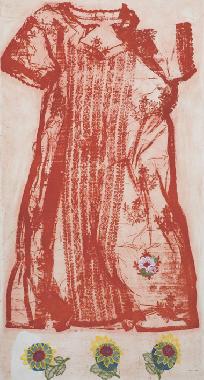
The small decorative knick-knacks, the everyday objects which our hands know and our eyes no longer notice, which fall out of attention, disappearing in the mechanized motion of routine only to resurface in dreams, photographs, and artworks. Things which grow into the skin of the everyday, merging into the interior world of the owners, offering comfort with their presence and familiarity. These are the favorite things that make up the visual language of Joya Shahrin Huq.
‘Who is the artist?’ is a common question from visitors to the gallery. And it is easy to say that the artist is an associate professor at the printmaking department of the University of Dhaka. That she studied in Maharaja Sayajirao University of Baroda, one of India’s best art schools. That she is married to Abdus Salam, a freelance artist and has traveled widely. But these are the biographical facts which can be found at the end of this catalog. To answer that question in all honesty, I would have to tell you about the rooftop garden that Joya maintains, that they have mango trees and orchids, and monstrous cacti, crammed into a small patch of concrete. That these flowers and leaves, are the same that you see growing in her artworks. I would have to tell you about the small imitation of a bull skull souvenir which sits idly next to a candle shaped like a white rose, the romantic imagery which once and for all belongs to Georgia O’Keeffe.
It would also be necessary to mention Joya’s dedication to the home, the family, and the kitchen – those three niches of a woman’s life. Food is a recurrent motif in her works here an aborigine, there a fruit bowl. As is clothing, garments which have characters of their own, stand independent of the wearer. It would be too obvious to say that Joya is a woman, and her art is about that.
The choice of title was important for this exhibition as it breaks away from the tradition of pseudo-poetic seriousness. Abandoning her golden dreams of utopia, it is the artist who questions the real conditions of the present. The artist acts as a scribe, documenting that which lies under the surface, between the headlines. Being a woman in Bangladesh is not only about rape, acid burns, micro-credit and garment factories. There is a stratum of women who are privileged enough to make choices, to have careers and not jobs, women who reflect on who and where they are in relation to society, and their thoughts, ideas, and confessions are no less important or revealing. Joya is in exactly that position.
The position is advantageous, but there is also a sense of seclusion and confinement, captured perfectly in the title of one of Joya’s works, Big Fish in a Small Pond. All the advantages are there- social mobility, career, friends, home, comfort, a wardrobe. But nowhere to go. The social calendar is bursting, but every event bleeds into the other. Always the same faces, the same shuffling of ideas.
Joya’s ability to internalize everything is what makes her works so interesting and sensitive. She does not steal from other artists, nor does she search for guidance. It is as if everything she sees becomes part of her visual vocabulary, falling into place within her, where a parallel world exists. And walking around Joya’s home it is easy to recognize objects from her work a lamp from a drawing, a shoe from a print. And it is unclear which is more real, the dusty object on the shelf or the vivid drawing. Who is the artist? The artist is a woman in front of a mirror, exploring the person within.
Date: 15.02.2013 – 03.03.2013
Venue: Bengal Art Lounge