

Of River and Earth
An Ode to Life and Nature
S. Manzoorul Islam
With Of River and Earth, Syed Jahangir continues to expand on his elemental imagery, and his exploration of nature – more particularly the relationship between man and nature. Although nature has remained an important preoccupation with Jahangir, it is seen in increasing poignancy and sympathy in his recent work – which at times border on the metaphysical or the mystical. He now goes for the ‘life of things’ in nature – as William Wordsworth did, nearly two centuries ago. Jahangir himself had tried to understand nature in its seasonal manifestations in his early watercolours, and was particularly attracted by the green hills of Chittagong Hill Tracts, or of Muree in Pakistan. Trees and tropical vegetation provided him with both an instant theme and rich, vibrant colours. As a watercolourist, his primary concern was to bring out the shimmering quality of the hills and landscape and the play of light and shade, in a manner reminiscent of the Impressionist. But Jahangir was more down to earth, always keeping an eye on the people who inhabited the landscape or its fringes, their daily life and living. As a result, his paintings always came alive with the life of nature and the life of the people engaged in different preoccupations.
In a phase that began roughly in the mid 1960s, Syed Jahangir took up abstraction, more as an artistic challenge in self-expression than in following the dominant trend of the time. As most of his friends and peers raced along the path of abstract expressionism, so did Jahangir, but he never completely alienated himself from the land and the people. They made their appearance even in his abstract work, sometimes in muted but suggestive details, sometimes in geometric configurations. Jahangir has always been enamoured with open spaces, particularly the sky and the river, and these were subjected to selective spatial treatment in his work.
After the country’s independence in 1971, Jahangir, like some of his contemporaries, began to take up political issues in his work, and this new preoccupation demanded that the treatment of these themes be straightforward, and dynamic. For a time, Jahangir practiced both abstraction and figuration, showing mastery in both. But his politics was of a personal kind, in which the common people and their welfare figured prominently. It was never power or, for that matter, social revolution that was his concern.
The return to figure also saw Jahangir explore the relationship of the people with the land and nature. He began to look closely at the vast life that goes around in the villages. He began to understand its vital energy as well as its quiet moments. Then he began to look passionately at the moments that energize people’s outer and inner needs – the calm of the evening, of silvery midnights, the moments of togetherness when people harvest the crops or fish in the river.
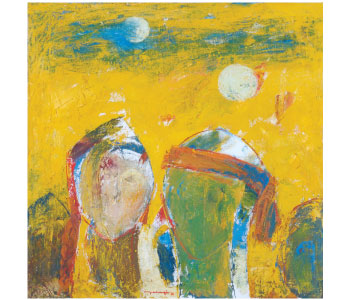
Gradually, the river, the boats, the open fields rich with golden harvests and fishing nets taut with expectation of a satisfactory catch became the recurrent images in his work. Earlier, Jahangir had dealt with quiet moments and special meanings in life symbolically, allegorically, even mystically (reflected in such titles of his exhibitions as Rejuvenation of the Soul, Vibration and In Quest of the Unknown). Now he is centrally concerned with how nature impacts on the total being of individuals – not simply their spiritual life but also their day-to-day existence. In the recent years, much of the dynamism and energy of Jahangir’s work come from his treatment of men and women at work. But then again, a quiet full moon hangs over all human enterprise, suggesting that behind all life force; there is the inevitable presence of nature. It is a benign and graceful presence – affirmative and restorative; it is significant that Jahangir does not paint storm scenes, or scenes depicting the aftermath of a cyclone – which is so common in this delta.
Of River and Earth shows once again Jahangir’s excited involvement with nature – and as in the previous couple of solo shows, with a cosmic vision as well. I have always admired Jahangir’s strong sense and treatment of space; his ability to turn a patterned composition (e.g., moored boats or fishermen flinging nets) into a transcendent image; his very distinct and by now signatured use of ultramarine and golden yellow; his persistence with the motifs (which often have a symbolic value) of the moon, the boat, the fishing net; his bold use of the foreground of a painting and his innovative use of texture. In this latest exhibition, he seems to have excelled himself in many areas, particularly in giving a quiet, meditative look to scenes which are otherwise hectic, such as scenes of harvesting. There is no sense of hurry in any of his composition, no unnecessary dabbling with colour, no effort to crowd meanings into his canvas. All is peaceful and serene, yet one never misses his sympathy with the men and women who people his canvas.
Of River and Earth has put together Jahangir’s usual acrylics and oil, a few water colours, and some spectacular ink drawings. These latter are a reminder of Jahangir’s versatility as an artist. The drawings have a wash treatment, which heightens a quiet contrast between the background and the foreground, of two clusters of images and forms – a characteristic of Jahangir’s art that one also sees in his larger work.
Jahangir is a tireless traveller through life with a keen eye for detail. Of River and Earth shows him with all his power of observation and empathy, of sensuousness and sensibility. I must mention here a couple of his ‘romantic’ paintings in which a couple romances in moonlight or reflects on love. These paintings show an artist who believes in the transforming power of love.
Date: 03.12.2007 – 17.12.2007
Venue: Bengal Gallery of Fine Arts