

The Bigger Picture
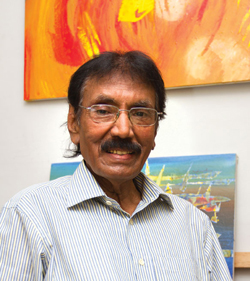
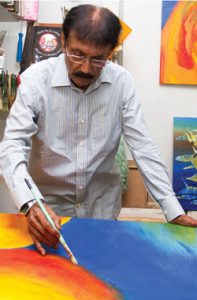
Syed Jahangir is considered a pioneer of the modernist art movement in Bangladesh. His paintings render scenes from rural life with precise detail and vibrant colours in both abstract and figurative styles. Jahangir worked as a freelance artist for many years and helped lay the foundation for the Bangladeshi art scene as we know it today, initiating the ‘Asian Art Biennale’ at Shilpakala Academy and the mobile art exhibitions in remote areas around the country. ICE Today chats with one of the great masters of Bangladeshi art to learn more about his career, his thoughts on the development of the local art scene and his upcoming exhibition at the Bengal Art Lounge.
Since graduating in Fine Arts from Dhaka University, you have been painting for over 55 years as a freelance artist. What has that journey been like for you?
When you work as a freelancer who is solely dependent upon their paintings, you have to do a lot of work just to get by. This means that you’re constantly thinking about your current pieces, what to do next and how that next project can be something new and exciting for the viewer. You’re solely focused on your art and its development. When I first started painting professionally, there was no way artists could live on their sales alone. So everyone was doing this or that on the side, such as illustrating book covers or teaching and so on. But I felt that after spending five years studying painting and having wanted to be a painter for so long, I should focus on it and hone my craft. So I painted vigorously. Of course, I had to struggle a lot. At the time, the majority of buyers and collectors of fine art in Bangladesh were foreigners who were only attracted to big names. My first exhibition was in 1957 at the British Council where some of my paintings were bought for around Tk. 60, which was a lot of money at the time. I was elated and slowly but surely my work came to be noticed by prominent collectors. Then I was able to go to the United States on a fellowship called the Leaders and Specialists exchange program under the Ford Foundation. For three months I traveled to around twenty different states such as Washington, New York and Florida, visiting their museums and galleries to see the works of both contemporary and old masters. I eventually came back here but was based in West Pakistan for a time, holding exhibitions at Rawalpindi, Karachi, Lahore, Islamabad and other provinces. The buyers were still mostly foreigners but my experience and education helped my work stand out. So I would say that my journey as a freelancer took me around the world in the pursuit of perfecting my art.
You are one of the few artists who have had the privilege of practicing your art in both pre and post liberation Bangladesh. What can you say about the experience? What do you think is different in your work?
Before the war I mostly worked with landscapes and portraits and dabbled in abstracts. But my post liberation pieces were completely different in terms of themes and content and had more abstract work. When I came back to Bangladesh in 1973 I found that the country was exhausted from months of conflict and strife but still had a strong spirit. People back then would work tirelessly, sometimes for very little pay, but never lose that spirit. This inspired me and I started painting a series called ‘Rejuvenation of the Soul’. I did some forty paintings on this subject, using colours and composition to capture this theme. Shortly thereafter the political situation became tense and unstable. That time I did a series called ‘Premonition’ where I tried to reflect these troubled times. But I stopped working on it after Sheikh Mujibur Rahman’s death and moved onto something else. I’ve done a number of different series like ‘Ecstasy’, ‘Vibrations’ and ‘Quest for the Unknown’, communicating these respective ideas through my use of hues, shading and compositions. They were well-received but over time I found myself becoming frustrated with abstractions and started doing figurative style paintings which I have continued doing for the past ten years.
Where do you see the art scene in Bangladesh going? What are your expectations and what would you like to see change?
Bangladesh is progressing very well. I must say that young artists are doing a lot of important and significant work, broadening the scope of what viewers expect when they go to an exhibition. They are also very keen to embrace new trends happening in the contemporary art world. I remember that when I graduated there were around forty or fifty students coming out of the Faculty of Fine Arts at the time. Now there are a whopping six thousand. The market is now much more competitive. I would like to see more paintings be collected by national galleries and organizations so that these artists can get more exposure. I think that we also need more critics. There was a time when Shilpakala Academy used to teach Art History and Art Appreciation in courses where luminaries from the art world like Professor Syed Ali Ahsan and Aminul Islam taught students not only how to draw but how to critique art as well. Critics are a crucial part of the art market as they not only bring an artist up in the scene but point out areas in their work that needs improvement. In foreign countries some collectors are wholly dependent upon critics, using their expertise to decide what pieces they should buy. I think we need to see more of that and in general there needs to be more writing on art. The existing body of writing seen in magazines and newspapers is good but can sometimes distance a lay reader by being overly complicated or bogged down with artistic jargon. I would like critics to keep their words simple so that more people can start to understand and appreciate the finer points of art.
What are your views on the ‘development’ of the art market in Bangladesh?
As I said most of the collectors in this region were foreigners. In West Pakistan there was a nice mix of both foreign collectors and local buyers who were wealthy and cultured. Now the market is stronger locally with artwork going to Bangladeshi patrons. I think a marked difference is the fact that more and more people are getting educated abroad and developing an appreciation for art. We need to create new buyers who understand art as well. If you’re buying, say, a refrigerator, you can compare different models and make an informed choice. If collectors are educated about art they can distinguish between good and bad works themselves and choose good quality work. There is also an element of competitiveness among local collectors. If I for instance buy two paintings by Mohammad Kibria, someone else will probably buy two more. People are also attracted to big name artists, which makes it difficult for new talent to emerge. I would like to see people buy works with the quality and not the name in mind. That way, a greater number of young artists will be able to carve a place for themselves in the market.
What will stand out in your upcoming show at the Bengal Art Lounge?
I have done mostly figurative work for the past ten years. My work consists of paintings of rivers, the land and people from my memory. I was born and brought up in the village and have images from that time imprinted in my mind, such as scenes of men and women working in the fields, cutting paddies and harvesting crops. These scenes find their way onto my canvases and are focused on the relationship between man and the earth or rivers. This upcoming exhibition will serve as a continuation of these themes and motifs. In addition I also developed a technique called black ink drawing where I use a spatula with ink. It makes for a very unique style and expression and I hope it will please those who come to see my exhibition. There will be around twenty of these drawings and twenty paintings, a good mix of two different stylistic representations of the same subject matter, that of man’s ties to the land.
Source: Ice Today