

Bengal Cinematheque – November 2015 – Chris Marker/Alain Resnais and Alfred Hitchcock
Bengal Cinematheque presented films and ideas of cinema’s greatest auteurs, shown at the highest quality, to encourage a community of emerging film-makers, writers and programmers in Bangladesh.
The event was free and open for all.
‘The art of living has no history: it does not evolve: the pleasure which vanishes vanishes for good, there is no substitute for it. Other pleasures come, which replace nothing.’
― Roland Barthes, Roland Barthes
Every film is historical—burnt into the untouchable, impossible past. A collection of gone moments listing an earnest index of our desires. Yet, the immediate experience of film, it’s revivification with light and movement, seems so real and so sincere that it lulls you. You are unprepared for the oncoming melancholia, the rise of that archaic anger. Cajoled into a re-animated past, when the ontological echo of the image fades, we journey back to the incoherent present, desolate and worse, full of nascent hope. Formless, in the quiet dark, as we collect our things, we long for more hallucinations, more time with what we have lost, and those who have lost us. The light outside the theatre is blinding and sad. The third cycle of Bengal Cinematheque inflames our greed for the traumas and pleasures of our past and then reveals to us their brutal, unbridgeable distance.
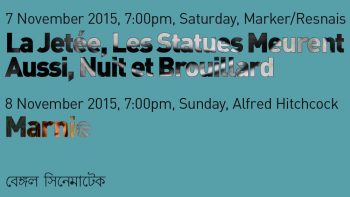
7 November 2015, 7:00 PM Saturday
La Jetée (Marker, 1962, 29 minutes, b+w)
The future, past, and present connect through desire. It is this desire that allows for the transmogrification of time. In static images the prisoner circles back upon life, which is to say, death.
Les statues meurent aussi (Resnais, 1953, 30 minutes, b+w)
The blank gaze and the pulsating compressions of white technology show us the art of black people. The beauty becomes self-hatred and hatred of power and its coded manifestations. Currency, appropriation, narcissism, the white, the black.
Nuit et brouillard (Resnais, 1955, 32 minutes, colour & b+w)
Systems coalesce around dawn flowers. Jewish bodies and bones burn and nails scape into the ceiling. The vast nadir of the soundless screaming. The universe should have caved in.
8 November 2015, 7:00 PM Sunday
Marnie (Hitchcock, 1964, 130 minutes, colour)
A con-artist moves coolly, discreetly through the world. Around her compresses waves of fantasy and yearning. She moves fast, but eventually, into the path of a fastidious hunter. Falling into his elaborate trap, at first she seems to acquiesce. Due to the hard exterior we are blind to the inward thrashing, caused by a totalising fear. As always, we are complicit. She escapes. The hunter tracks her down. We see an ancient form of sickness in both of them—desire is continually tempered with violence and tenderness. They journey to the beginning of time and she is deconstructed and unconcealed. Yet again, the man is proven predictably right. He is always in control. Dispelled of myth and mystery, everything seems very still and very small.