

Rokeya Sultana 2001
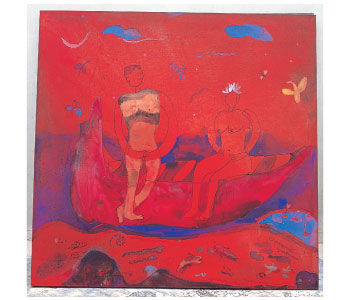
The remote and the near
Rokeya’s solo exhibition
Over the years, Rokeya Sultana has evolved in terms of images and colours, and her ability to look for subjects in the most common, mundane experiences. Yet when she interprets these experiences in delicate forms and through superb application of paint they turn into moving representations of our time. Her Madonna series for example, sifts through the interstices of the divine and the mundane, but so much of her remembered experiences, and the emotions invested in relationships (mother and child being the most paradigmatic here) are at stake that the sublime and the spiritual give way to the ordinary and the intimate. In the Madonna paintings Rokeya is actually stringing together a series of epiphanies that are of the most secular, earthly kind, in which life is revealed in all its strengths and appeals, as well as its challenges. Rokeya’s Madonna thus can be seen on many levels-as a feminist taking up her place in a predominantly male world, and struggling to protect her own space; as mother earth protecting her legacy before man is fit to claim it; or as a quintessential woman of grace and poise brooding over a wretched earth which man has laid waste. One can trace an influence of Anjolie Ela Menon in the Madonna series, but Rokeya’s treatment avoids the iconic and the symbolic (Anjolie’s Madonna representing purity, and so on).
The possibilities of all these varying interpretations point to the essential strength of Rokeya’s work. She is a complex and thinking artist, one who likes to explore new grounds as styles change and new demands are created. Yet there is something distinctive about her style: it has basically has to do with the way figures tend to draw attention to themselves without dominating the canvas, and then interact with colour and other elements of her visual vocabulary. There is a simplicity in her formal arrangement, which sometimes exploits the elements of na’ve (or even children’s) art, but the harmonious juxtaposition of paint areas, the dynamic and flowing line (which, instead of separating figures, seem to integrate them in the composition) and her delicate attention to details combine to give her work a focus. That focus may be as diverse as a woman’s search for identity, a way out from the conflicting demands of the city (coupled with predicaments placed by modernity) or the despoiling of nature. In less versatile artists, these concerns could sound like public themes. But Rokeya does not allow her concerns to solidify into an overriding themes. For one thing, each of her works is a different (and new) interpretation of the concern. Art and idea are not put into separate categories; they are often one in Rokeya’s work.
That is why it takes some time to realize that Rokeya’s work over the year has increasingly sought to probe, what in our common discourse would be considered political or at least politically correct issues: a concern with ecology or the subalternity of women, for example. Yet, these do not sound like battle cries. All Rokeya does is to turn to the human, intimate side of the issues, and narrate them in touching details. Interacting figures and half figures, paints that animate the interior spaces of the composition-these are aspects of her style that state her idea, but in the end the viewer finds its echo in his own mind, from the calm yet haunting images he carries home with him.
All these evolving, expanding and integrating aspects of her art can be seen in the latest solo exhibition of her work. It is almost 7 years since Rokeya had a solo exhibition in Dhaka-although one of her solo exhibitions travelled to Calcutta (Chitrakut Gallery) and then to Karachi (Choukhandi Gallery) in 1997. In this Bengal Gallery exhibition Rokeya has put together a number of paintings done in gouache or tempera on paper (and then pasted on canvas) and some on plywood. There are some pen and ink and wash drawings on paper as well. Rokeya finds it comfortable to work with gouache and tempera since they are great to have flat, uniform areas of colour, and fill up any area with flat, opaque colour. The paintings depend heavily on colour-which, in keeping with her increasing control she seems to be exercising on colour, is delicately nuanced, evocative or bold. Rokeya’s preference this time is a stronger palette: red, blue, green and black (green is indeed a revelation). But the presence of figure is also distinctive. Not simply human, but animal figures-goats, cows-as well as snakes provide a ground of interaction between man and his natural world. There is a representation of a mother snake with her child-an animist variation on the Madonna theme, it seems. But their presence, formally, is also decorative; they appear to leave the burden of rescuing the world to man.
Rokeya concentrates on the figure when she deals with the concerns of our time and with relationships. But when she shifts her gaze to nature and the state of our environment, figures disperse. There is perhaps a hint in this scattered representation of figures: Nature is not a passive agent that will endure degradation; it may decide to take things in its own hand. In that eventuality, Rokeya sees a loss of innocence and a severance of bonds between man and nature resulting in a scattered existence for man.
The present exhibition shows Rokeya developing in three different directions: she has taken up a more intense involvement with colour; she has expanded the scope of space in her compositions, and her lines have become very light and delicate-in fact she is trying now to use fragile lines to make strong statements. This apparent contradiction is resolved if we remember how Rokeya’s female figures, traditionally considered fragile and weak, have a strong presence as they chart their own territories, and disencumber themselves from traditional expectations, norms and customs. The power that they hold over their own destinies is not reflected from any source, but is a construction of their own identity.
Rokeya loves to work on a large canvas. When she begins to work, she actually embarks on a journey which leads her through different experiences, moments and epiphanies to a quiet centre from which she can look back on history and time, and settle on enduring images. There is thus no agitation in her painting, no loud statements, but a mood of quiet thinking. While she was in Shantiniketan, a place marked by meditative landscapes, Rokeya found that every day she was discovering a bit of herself-who she was, what she wanted to do, and the why and how of things. Her works still reflect that movement towards a point of time and a philosophical moment when many unresolved mysteries of life become meaningful. However, Rokeya does not allow her paintings to become overtly mystical or brooding, they are just narratives of a sensibility on a journey through life.
Rokeya has been noted for her accent on the unexpected as she brings the most remote experiences into the fold of the familiar. Here, in this exhibition, the same characteristic is on display.
S. Manzoorul Islam
Dhaka University
Date: 25.10.2001 – 14.11.2001
Venue: Bengal Gallery of Fine Arts
Entry condition: open to all