

Seven From the 70s
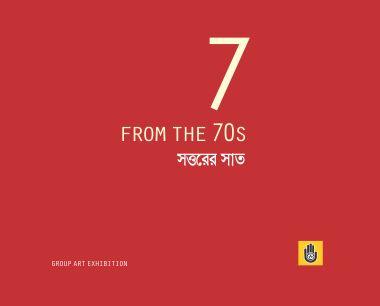
The material condition of one age differs from another, and we may come to determine this at many different social and individual registers. The spiritual longing and desire, on the other hand, inhabits our collective ‘body politic’, and manifests in mortal bodies, often traveling across time. They, at times, overwhelm us and make us rethink our lives and the position we cast to appear as thinking and acting beings. That we often reposition ourselves in the new realities empowered by such immaterial properties is also a testimony to our capacity to transcend the given social climate. The seven artists in this exhibition are related to one another by way of their shared past – they studied together at the Institute of Fine Arts (currently Faculty of Fine Arts, Dhaka University) in the first half of the 70s. They also share this idea of transcendence, though, in divergent ways. If some are given to non-objective articulation, the rest afford a referencing to arrive at images where there are either traces of self-effacement, or a stylistic pre-occupation that verges on the subjective. Entrenched in the their quest for the absent or nonexistent desiring condition of the social/individual self vis–vis their immediate realities of post-71 Bangladesh, their work seems, in the final analysis, as if they are the production of a gaze, one that is deployed to search for the lost terrain both real or imaginary. Formulated by the idea of transcendence and memory, such a gaze developed in the urban climate helped them cast a disinterested, yet aesthetically fraught perspective, which is geared towards the deconditioning of the mind of the viewer. This led them to different destinations, but their achievements can also be clustered under a common ethos one which is characterized by the nostalgia for the Tabula Rasa a blank slate, to employ an overused trope in an altered context — to allude to a space unscathed by tumults of their time, or plain urban encroachment on our psyche. We witness in Naima Haque, one of the seven artists known for her collage and mixed media works, a thirst for a spatiality where scraps of paper, or a suggestive motif, or even a few lines accompanied by stipples and dots create an ecology eluding a sense of fullness a totality which we lose sight of, treading on the physical topography of reality. The deceptively simple compositions of this artist, who brings into play a fresh new concept of womanhood while conflating a minimalistic formal logic with the veiled intention to be socially relevant, seem like attempts at achieving an inversed visuality where shapes, form and space are in eternal retreat. Though related to Naima through the thread of love and matrimony, Nasim Ahmed Nadvi works from an altogether different register to address similar spatial purity. Nadvis preoccupation is primarily with nature and its pristine condition. He harnesses its virgin spirit, depicting, in the most elemental form, water, air and land employing a gaze akin to that of the Zen masters. As he goes on to create his imagery through the play between absence and presence, often representing landscape, Nadvi filters sense-data to get at what we may call the ethereal visage of nature giving rise to the meditative moments that enliven our gaze. The purity of space sought by the couple mentioned above, exteriorized in their unique ways of expression eliciting two distinct dispositions, appears in many other forms in the work of their compatriots. These artists from the batch of 1975, seem to echo the same spirit, but, indisputably, through their respective aesthetic protocol. They seem divergent enough to eke out their own niches to make the created pictorial space of their own. Alamgir Huque, who has been resident in Canada since 1990, is well known for his printmaking where one encounters a spatial construction of formal rigour. Though inclined to encapsulate natures energy, the compositional logic employed and the surface quality achieved in his works seem to freight his art into the direction of Tpiess diction, one which Alamgir tempers with to transform into a formalized version of his own. His works done on canvas, however, seem looser in constitution, and speak of momentary lapses one encounters and the ecstasy one feels, during the process of painting. Farida Zaman, on the other hand, veers towards a method of ‘recall’ that uses easily recognizable elements drawn from experiences — visual and otherwise — associated with the rural. Her fishing nets, though a reference to a rural life in Bangladesh, can also be seen as an enactment of a return to an imagined space where fish, cats stand for an unfurling of the Bengali psyche re-awakened through the process of remembering. With similar zeal for psychic unfurling, Showkatuzzamn seems to share a kinship with Farida Zaman, his wife. The engine of recall rattles here surreptitiously as the artist is out to appeal to the Bengali identity in a silent, yet deliberate manner. Iconic in character, each painting is based on a single image placed in the mid-zone of the canvas, and is forwarded as a narrative to appeal to the collective memory; these acrylic on canvas transport us chiefly to the lost virgin space in the urban climate. Shadhana Islam, perhaps, is the most eloquent exponent of the return to the rural ethos we detect in the two above-mentioned artists. Often sourcing on the representational technique of the traditional nakshikantha by rural women, Shadhana inscribes the painted space with motifs and elements to mirror a desire to recollect a mutating tradition. T.A. Kamal Kabir, who is connected with Shadhana through nuptial bond, seems to stand at a distant from his wife by way of his painterly gestures and suggestiveness that he often banks on. The ecology of his work, where the colour blue appears to be of singular significance, incorporates suggestive bodies of fish, through which the rural-natural is recalled. Yet his entire oeuvre seemed to be infused with the painterly zeal for attaining a resonating surface. Nostalgia, says Simon and Tom Bloor, in a joint interview published in a British journal, looks to overly idyllic past that never was. Yet, when faced with the urban moral decay and the resultant degradation of the social space, we strongly feel the need to hinge our existence on such a purifying force emanate, as it does, from nostalgia. That the urban ecology runs counter to our micro-ecology of the body, is a fact. And it also provides these artists, who have journeyed through life keeping in touch with one another, with the premise to bring to life an aesthetic protocol, which, in their personalized way, is exploited by each to recall the lost space be that rural, real or imaginary.
Date: 22.03.2013 – 30.03.2013
Venue: Bengal Shilpalaya
Organiser: Bengal Foundation