

Heroes
 Koh-i- Noor, the ‘Mountain of Light’, the largest cut diamond of the world, that changed hands between various factions, came into Queen Victoria’s possession after the second Anglo-Sikh War, which resulted in the Punjab region falling under British rule in 1849. The Sikh Maharani Jind Kaur was granted asylum in Nepal in April 1849. In January 1861, her son Duleep Singh was allowed to meet her in Kolkata, after thirteen years of separation. Both proceeded to London from there. They were barred from visiting Punjab. Jind Kaur died in London in 1963. Raja Duleep Singh’s daughter Sophia was popular in high society in London, for her strong personality and lifestyle. Her mother Bamba Muller was half-German and half-Ethiopian, while Queen Victoria was her Godmother.
In nineteenth-century England, women did not have the right to vote. Emmeline Pankhurst and her daughters Christabel, Sylvia and Adela Pankhust started a movement known as ‘Suffragette’ or ‘Votes for Women’. Sophia Duleep Singh and many other Indian women, from the elite right down to the ordinary, became involved in it. ‘Votes for Women’ was one of the most important feminist movements in the western world. Female protesters shut down churches, shops and offices, in order to get government attention. Suffragette also resulted in militancy. Sometimes the protestors set off bombs in letterboxes or turned up on the street with toffee hammers to smash shop windows (they were easily able to hide the small toffee Hammers). The activists also bombed empty buildings, burnt letterboxes, and destroyed paintings in art galleries, to strengthen their political statement.
Suffragettes had their own flag with three colors—white for purity, purple for dignity and green for hope. Their flag in America had a different connotation in terms of the colours. Purple was the colour of loyalty, white stood for purity, while gold was for light and life. The activists raised funds for their campaign and produced scarves with ‘Votes for Women’ written across in three colors. They had artistic placards, a number of books and publications, and their own newspaper.
During the movement many suffragette protesters were arrested and sent to the Holloway Prison in North London. Back then, jails were full of women political prisoners. There was a massive demonstration in Hyde Park, London, and the police arrested many protestors from there, including Emmeline Pankhurst. This day is known as ‘Black Friday’. Sophia Duleep Singh was also arrested and abused by the police but they let her go because of her position in society and that she was the god great-daughter of Queen Victoria.
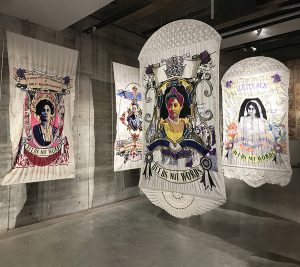
Many suffragettes protested the government’s refusal to treat them as political prisoners, by going on hunger strike. The government responded by force-feeding them. This was akin to torture. The hand-embroidered panels titled ‘Heroes’, the sculpture pieces ‘Toffee Hammer’ and ‘Force-feeding’, refer to aspects of Britian’s suffrage movement, but in the wider sense, they point to the powerful concoction of political and historical processes that are responsible for disenchantment and suppression of rights.